
I work as a mobile veterinary technician in Faisalabad, making home visits for pets ranging from pampered indoor cats to semi-feral strays that people try to care for in backyards. One thing I get asked surprisingly often is how cats always seem to know when food is being opened, even if they are in another room or sometimes even outside the house.
I have seen cats appear out of nowhere when someone opens a packet of chicken or tuna, and it still surprises new pet owners. Over the years, I’ve learned that their sense of smell is doing far more work than most people realize.
The strength of a cat’s nose in real situations
From what I’ve observed during home visits, a cat’s sense of smell is easily one of its most dominant survival tools. In controlled environments and everyday homes, cats can detect food scents from surprisingly long distances, often several hundred feet in ideal conditions. I’ve seen indoor cats react to cooked meat from another floor of a house, especially when air moves through open doors or vents. The real answer is not a fixed distance but a combination of scent strength, airflow, and what else is in the environment competing for attention.
On a customer visit last spring, I remember a household where a cat would wait near the kitchen window every evening, even before dinner started cooking. The owner thought it was routine behavior, but the cat was reacting to early scent particles carried by air currents long before the food was even placed on the stove. In real homes, smells rarely stay contained, and that makes a cat’s ability to detect food feel almost uncanny. It is not magic; it is just biology working very efficiently.
Wind direction matters more than most people think. If a breeze carries scent particles directly toward a cat, it can pick up that smell from much farther away than in still air. I’ve noticed outdoor cats reacting to grilled food from neighboring houses, especially in dense residential areas where cooking happens at similar times. In calm conditions with no airflow, that same scent might not travel nearly as far.
What makes food smell travel so far for cats
Cats have around 200 million scent receptors, which is a major reason they outperform humans in detecting odors. I’ve handled cats in clinical settings, and they responded to tiny traces of food residue on people’s hands or clothing that people didn’t even realize were there. Their noses are designed to detect protein-based scents, which makes meat and fish especially powerful triggers. That’s why a sealed bag of treats can still attract attention if it is not fully airtight.
In my work, I often recommend that owners store strong-smelling food in containers rather than leaving it in thin packaging. I once saw a cat manage to open a soft bag of dry food left on a counter, guided entirely by smell and repeated curiosity. The interesting part is not just distance but sensitivity, because cats can detect diluted scent molecules that humans completely miss. Even a faint odor trail can be enough to guide them across a house.
Indoor airflow systems like fans, air conditioners, and open windows also extend how far scent can travel inside a home. I have seen cats sitting in hallways simply because air currents were carrying kitchen smells toward them. That is why it sometimes feels like they are “watching” you cook from afar. In reality, they are following invisible scent paths that we rarely notice.
In one clinic I worked in, we had a small observation room where we used food to calm anxious cats during checkups. A local pet behavior service and a local veterinary clinic were used to understand how scent placement affected stress levels during visits. We learned that even placing food just outside a closed door was enough to change a cat’s behavior inside the room, showing how quickly smell travels through small gaps and airflow changes. It was a simple setup, but it made it clear how sensitive their detection really is.
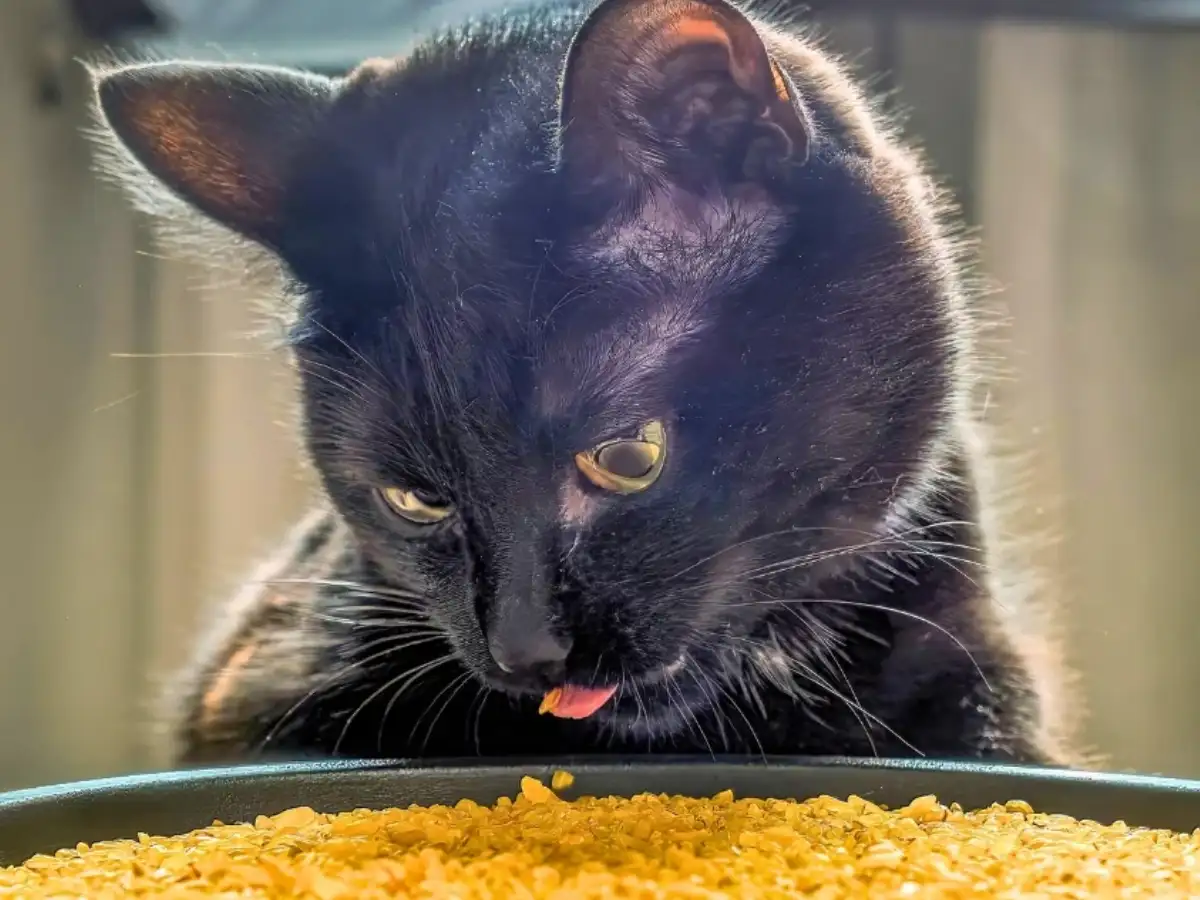
Distance limits and what actually blocks scent
Even though cats have strong noses, there are limits to how far they can reliably detect food. Strong odors like cooked fish or roasted meat can travel far outdoors, sometimes over 200 to 500 feet, depending on wind conditions. However, obstacles such as walls, sealed windows, and heavy indoor insulation significantly reduce that range. ed environments, the distance drops to just a few rooms.
Humidity and temperature also affect how scent particles move. On hot days, I’ve noticed smells spreading faster but fading more quickly as air circulation increases. In cold