
I work as a rural wildlife handler and stray animal rescuer around the outskirts of Punjab, where houses meet fields and small irrigation canals cut through farmland. Over the years, I’ve been called to remove snakes from storage rooms, courtyards, and even poultry sheds, often while cats are already part of the property.
People frequently ask me whether snakes are afraid of cats, and my firsthand experience shows that their relationship is based on environmental opportunity and caution rather than simple fear or dominance. Instincts and survival drive their encounters more than any clear predator-prey dynamic.
How snakes actually respond when a cat shows up
In most cases I’ve handled, snakes do not “recognize” cats in the emotional way humans imagine. A snake reacts to vibration, heat, and movement patterns rather than identifying another animal as a predator in a personal sense. I’ve seen a rat snake freeze the moment a farm cat entered a shed, but that reaction was more about avoiding sudden movement than fear of the cat itself. One evening during a call near a wheat storage room, a cat paced near a corner while a juvenile snake stayed completely still for several minutes until both lost interest and moved away separately.
There are situations in which cats indirectly influence snake behavior. A cat’s hunting posture, quick pounces, and constant scanning can create a hostile environment for a snake trying to move unnoticed. I remember a customer last spring who had a semi-feral cat that routinely patrolled his courtyard, and snake sightings dropped noticeably during warmer months, though that could also be linked to seasonal shifts in rodent populations. I’ve also noticed that some snakes choose escape routes faster when a cat is present, but that looks more like risk avoidance than fear in the emotional sense humans project onto animals.
Where encounters become unpredictable in rural spaces
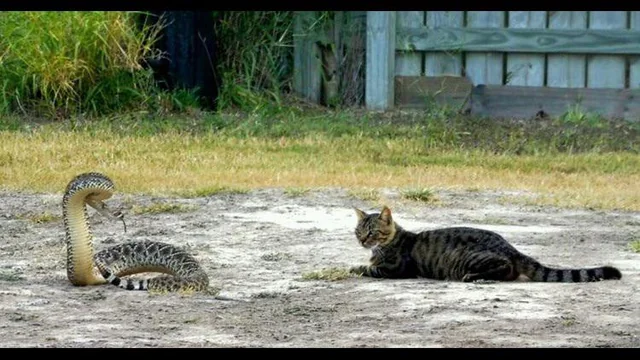
In tightly packed rural homes where grain, firewood, and livestock feed are stored close together, snakes and cats sometimes cross paths without warning. I’ve been called to a storage shed where a cat cornered a small, viper-like snake, and the situation escalated only because the snake felt trapped, not because it was afraid of the cat. In many of these cases, both animals are simply reacting to confinement and pressure rather than a clear predator-prey hierarchy.
During a field visit for a local awareness session, I told farmers that relying solely on cats for snake control is unreliable. A nearby veterinary clinic that also handles minor wildlife incidents sometimes sees similar cases: cats bring in injured snakes but also get bitten themselves when they misjudge distance or timing. That detail matters because it shows the interaction is not one-sided fear but a risky exchange where both animals can miscalculate under stress. I’ve seen cats retreat quickly after a failed attempt at striking, while snakes slip away into cracks, both prioritizing escape over confrontation once the moment turns dangerous.
What actually influences a snake more than a cat’s presence
The strongest influence on a snake’s behavior in these encounters is environmental pressure rather than the cat itself. Temperature changes, available cover, and vibration patterns from footsteps matter far more than the identity of the animal making those sounds. I’ve tracked movement patterns in farm buildings where snakes repeatedly returned despite cats living there, simply because the rodent population made the area worth the risk.
One winter call near an irrigation pump house clearly showed this. A snake stayed under stacked bricks even while two cats walked nearby multiple times, and it only moved after I lifted part of the structure and changed the airflow and light. That moment stayed with me because it showed how indifferent the snake was to the cat’s presence until environmental conditions forced it to shift. I also noticed that cats tend to lose interest quickly unless movement is obvious, which gives snakes more chances to slip away unnoticed.
When cats help and when they don’t in real snake encounters
Cats can sometimes reduce rodent activity, which, in turn, indirectly lowers snake visits, but this effect is inconsistent in the field. I’ve worked on properties where a single outdoor cat seemed to keep both rats and occasional small snakes away for months, while another nearby farm with multiple cats still had regular snake sightings in storage corners. The difference usually came down to cleanliness, food storage habits, and structural gaps rather than the number of cats present.
In one case, a homeowner assumed his cat would protect the entire compound after it killed a small snake near the wall. A few weeks later, I had to remove a larger snake from the same property because it had entered through an uncovered drain. That pattern repeated often enough for me to stop treating cats as reliable snake deterrents and instead view them as opportunistic hunters that occasionally overlap with snake territory but do not control it.
Over time, I’ve learned these encounters are shaped by environmental pressures and survival instincts more than by fear or dominance. Each interaction is a negotiation for safety and escape; neither cats nor snakes consistently controls the other. The outcome depends on alertness and available exits, highlighting how environmental factors outweigh species relationships.